

When it comes to the best umbrellas for wind and rain, the secret lies in a combination of a flexible fibreglass frame, a double-vented canopy, and high-density fabric. It's this specific set of features that allows an umbrella to flex in strong gusts instead of inverting, all while keeping you completely dry. Your standard, cheap brolly—the kind you grab for a few quid at a corner shop—simply lacks this level of engineering, making it a liability in anything more than a light shower.
Why Most Umbrellas Fail in Harsh Weather
We’ve all been there. That sudden, gut-wrenching snap of an umbrella turning inside out on a blustery street isn't just a stroke of bad luck—it's a failure of design. Most off-the-shelf umbrellas are built with thin metal ribs that simply can't handle pressure and flimsy canopies that behave more like sails. This leads to a frustrating and expensive cycle of buying, breaking, and replacing.
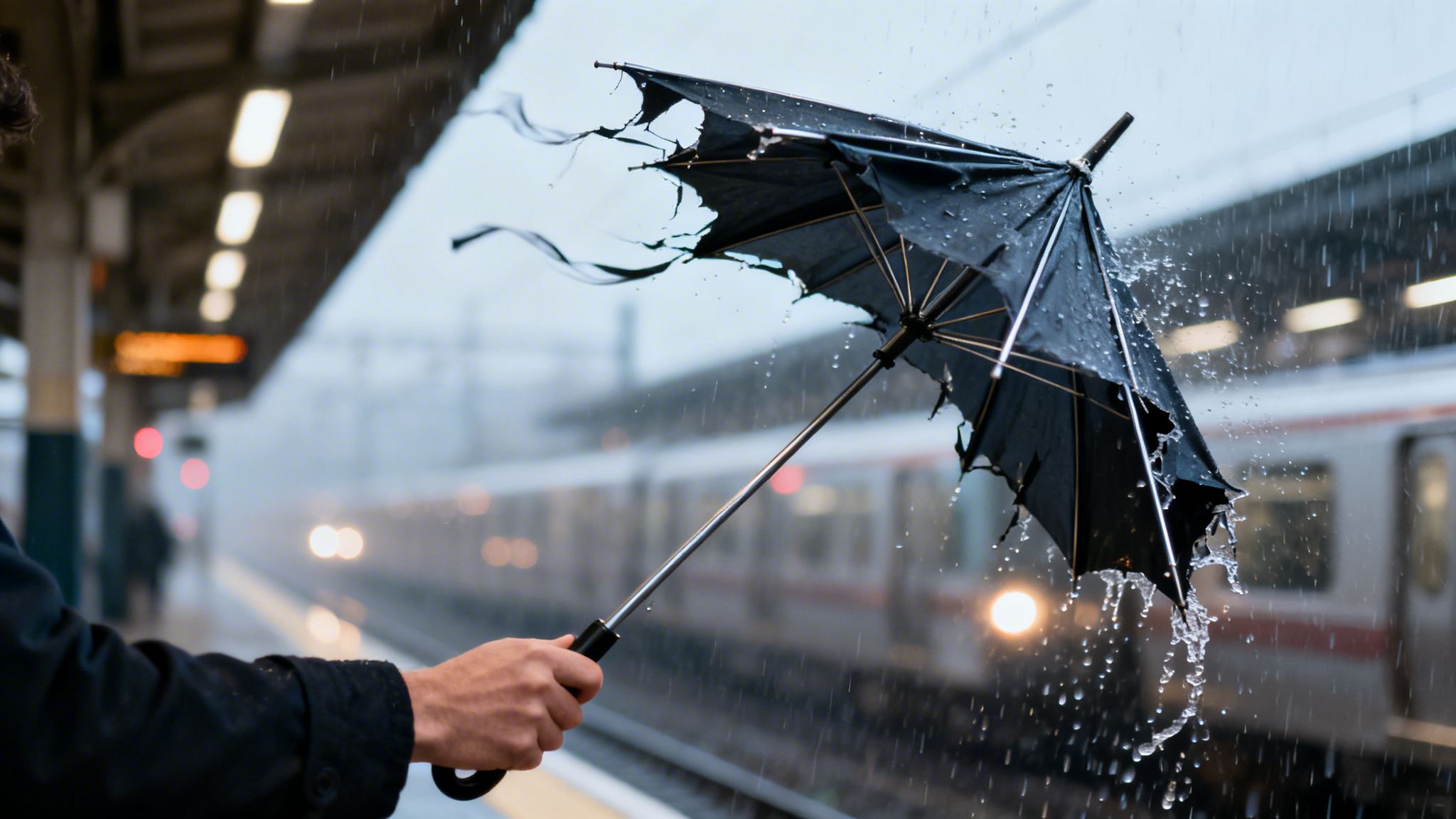
Common Points of Failure
Think about the daily commuter fighting with a mangled umbrella on an exposed train platform. That all-too-common scene perfectly illustrates the main weak points we see time and again:
- Weak Ribs and Frame: The vast majority of budget umbrellas are constructed with brittle metal or cheap aluminium ribs. The moment a strong gust hits as you round a windy city corner, the force is too much for these materials, causing them to bend out of shape or snap completely.
- Poor Canopy Design: A single, unvented layer of thin fabric is a recipe for disaster. It catches the wind, placing enormous strain on the frame and practically guaranteeing it will invert. Imagine trying to hold a solid kite in a storm—that’s exactly what your umbrella is doing.
- Insufficient Coverage: Many compact designs might seem convenient, but they often leave your shoulders, legs, and bag exposed to driving rain, defeating the whole purpose of carrying an umbrella in the first place. You arrive at the office with a dry head but soaked trousers from the knees down.
The answer isn't to just buy another disposable brolly. It's to understand what makes an umbrella genuinely weatherproof—from the materials in its frame to the cleverness of its canopy. Once you know what to look for, you can finally invest in a reliable tool that won't let you down.
The Anatomy of a Truly Windproof Umbrella
What really separates a dependable storm brolly from one that crumples at the first serious gust of wind? It's not magic, it's engineering. The best umbrellas are built from the ground up with specific materials and smart design choices that work together to stand up to the elements. Once you know what to look for, you can spot a quality umbrella that will see you through years of bad weather, not just one or two downpours.
The frame is the skeleton of any umbrella, and its ribs are the most critical part. You’ll find that cheap, disposable brollies almost always use flimsy, brittle metal that bends backwards and snaps under pressure. In contrast, a genuinely windproof umbrella uses flexible, reinforced fibreglass ribs. This material is designed to give and flex when a powerful gust hits, absorbing the force rather than fighting against it. A practical example is when you're walking between tall buildings that create a wind tunnel; a fibreglass frame will bend with the gust and then pop back into shape, whereas a metal one would likely flip inside out and break.
Stronger by Design
It’s not just about the material, though; quantity matters too. A higher number of ribs creates more points of support across the canopy, which drastically reduces the chances of it deforming or inverting in the wind. It's a simple idea: more reinforcement leads to a stronger, more stable structure. A great example is the CLOUDHAUS Clip, which features 48 ribs for truly exceptional stability.
This level of reinforcement isn't overkill, especially when you consider the British weather. With parts of southern England seeing over 100 'windy days' a year with gusts topping 40 mph, it’s no wonder that real-world tests show up to 70% of standard umbrellas snap under that kind of strain.
The Canopy and Its Clever Features
Beyond the robust frame, the fabric and design of the canopy play an equally vital role. Look for a high-density fabric like 210T pongee. Its tight weave makes it properly waterproof, not just "water-resistant," so you stay completely dry. For example, in a heavy downpour, water on a cheap nylon canopy will start to soak through and drip, while on 210T pongee, droplets will bead up and roll right off.
A double-vented canopy is perhaps the single most important feature for wind resistance. This clever design uses overlapping layers of fabric to create vents. Wind can pass straight through these gaps, releasing the pressure that would otherwise flip the umbrella inside out. Think of it as a safety valve for your brolly.
By checking for these key elements—fibreglass ribs, a high rib count, a dense canopy fabric, and a vented design—you can confidently tell whether an umbrella is built to last. These are the details that turn a flimsy accessory into a reliable piece of everyday gear.
Finding the Right Umbrella for Your Lifestyle
When you're searching for the best umbrellas for wind and rain, it's easy to get lost in the technical details. But the truth is, the "best" umbrella is the one that actually fits how you live. A model that’s perfect for a weekend traveller will likely be a clumsy burden for a city commuter, and vice versa.
So, let's put the specs aside for a moment and think about your day-to-day. If you're an urban professional, you know the struggle: do you go for a tiny, quick-deploy umbrella that vanishes into your briefcase? Or the sturdier, full-sized stick umbrella that offers real coverage when the heavens open? The compact model is a dream for convenience, but the stick umbrella often has a stronger frame and a wider canopy, which is the difference between arriving dry and arriving with soaked trouser legs.
Matching Your Umbrella to Your Needs
Frequent travellers face a similar trade-off. An ultra-lightweight travel model is fantastic for keeping your luggage weight down, but it can feel a bit flimsy when a sudden squall hits. A slightly heavier, more robust travel umbrella might give you the confidence you need when you're far from home. It all comes down to whether you value absolute portability over all-weather reliability. For instance, if you're backpacking through Southeast Asia during monsoon season, the sturdier option is a wise choice.
Then you have those who need serious coverage and one-handed operation—parents with a pushchair or dog walkers with a lead in hand. For them, a full-sized, golf-style umbrella is often the only sensible choice. Its huge canopy can shield more than one person, and a good automatic-open button is an absolute lifesaver when your hands are full. Picture trying to get a toddler out of a car seat in the pouring rain; that one-handed open makes all the difference.
Your local weather is the most important factor of all. If you're constantly battling gusty winds on the coast, a vented, double canopy should be at the very top of your list. For those in sunnier climes, built-in UV protection is a feature you shouldn't overlook.
This simple decision guide can help you start.
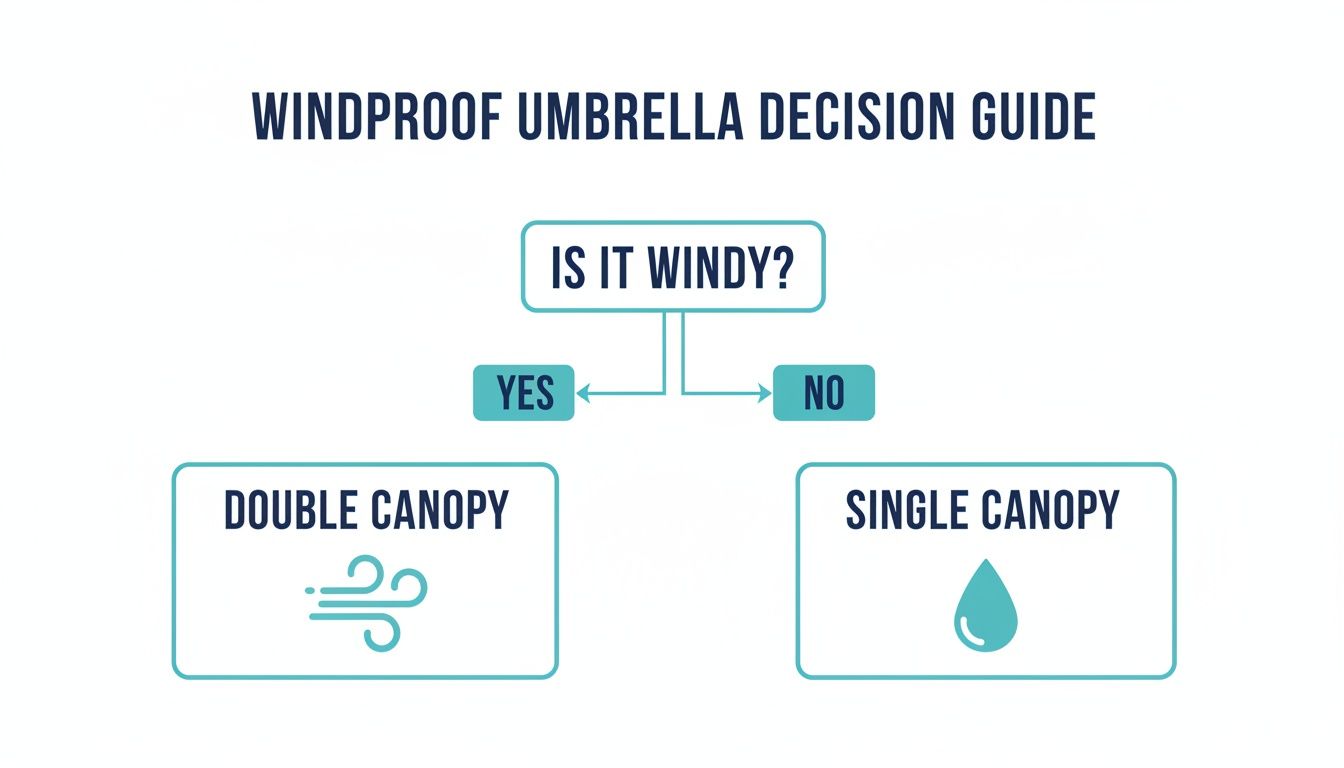
As you can see, the choice often begins with wind. A double canopy is specifically engineered to let gusts of wind pass through without turning your umbrella inside out, while a single canopy is perfectly adequate for calm, rainy days.
Umbrella Matchmaker: Find Your Perfect Model
To make things even clearer, we’ve put together this quick guide. Just find the user profile that sounds most like you to see which features will serve you best.
| User Profile | Primary Need | Recommended Type | Key Feature to Look For |
|---|---|---|---|
| The Daily Commuter | Portability & Speed | Compact Auto Open/Close | A fast, reliable deployment mechanism. |
| The Frequent Traveller | Durability & Low Weight | Lightweight Travel | A strong fibreglass frame that won't weigh you down. |
| The Parent/Dog Walker | Maximum Coverage | Golf-Sized Stick | A large canopy diameter (over 120cm). |
| The All-Weather Adventurer | Wind Resistance | Double Canopy Windproof | A vented canopy and reinforced ribs. |
By thinking about your lifestyle first, you can zero in on the features that matter. This way, your next umbrella will be a trusted companion for years, not just another broken brolly destined for the bin.
Here are a few final pointers based on these common scenarios:
- For the Daily Commuter: A compact umbrella with a fast, automatic open/close mechanism is a must for navigating packed streets and hopping on and off public transport.
- For the Frequent Traveller: You need to strike a balance between a low weight and a strong fibreglass frame. A model that is both light and wind-resistant means you’re ready for anything without adding bulk.
- For Maximum Coverage: If you need to shield yourself, a child, or your weekly shop, nothing beats a golf-sized umbrella with a large canopy diameter (over 120cm). Many of these also offer excellent sun defence, and you can learn more by reading our guide to finding an umbrella with UV protection.
How to Test and Maintain Your Umbrella
Think of a quality umbrella as an investment. How you treat it day-to-day will have a massive impact on whether it survives a single season or serves you well for years to come. A little bit of care goes a long way.
For instance, if you have an automatic umbrella, resist the urge to force it shut. Always use the button to collapse the canopy first, then guide the shaft down from the top until it clicks securely. Forcing the shaft down without using the button is a common mistake that can wreck the internal spring mechanism, which is one of the most common failure points.
Simple Checks and Proper Care
Before you get caught in a real squall, it’s worth doing a few quick checks at home. This is the best way to get a feel for the build quality and make sure it’s ready for whatever the weather throws at it.
- Check the Stitching: Have a close look at the canopy, paying special attention to where the fabric meets the tips of the ribs. You want to see tight, even stitching with no loose threads in sight. Bad stitching is often the first thing to give way, causing the canopy to detach from a rib in high wind.
- Test the Mechanism: Open and close the umbrella a few times. Does the shaft glide smoothly? Any sticking, rattling, or hesitation is often a sign of cheap, poorly fitted parts. A good mechanism feels solid and dependable from the first use.
- Flex the Ribs: Gently bend one of the ribs. A good fibreglass rib will have a bit of give and spring right back into shape. Cheaper metal ribs, on the other hand, will feel rigid and are more likely to crease or snap under pressure.
Proper storage is just as important. After coming in from the rain, always leave your umbrella fully open to air-dry. It’s a straightforward step, but it’s the single best thing you can do to prevent rust on any metal components and stop mould from taking hold. For example, leaving a damp umbrella rolled up in its sleeve in the bottom of a bag is a surefire way to get that musty smell and potential fabric decay.
Once it’s completely dry, pop your umbrella back into its protective sleeve. This keeps it tidy, of course, but more importantly, it protects the canopy fabric from getting snagged or torn by keys, pens, or other sharp objects in your bag or car.
This growing appreciation for durable, well-made umbrellas is reflected in the market itself. The UK umbrella market is projected to see a compound annual growth rate (CAGR) of 4.2% through to 2032. With online shopping making it easier than ever to find high-performance models, consumers are increasingly choosing quality. You can see more on this trend by reading the latest market research available on 6wresearch.com.
A Closer Look at CLOUDHAUS: Putting Theory into Practice
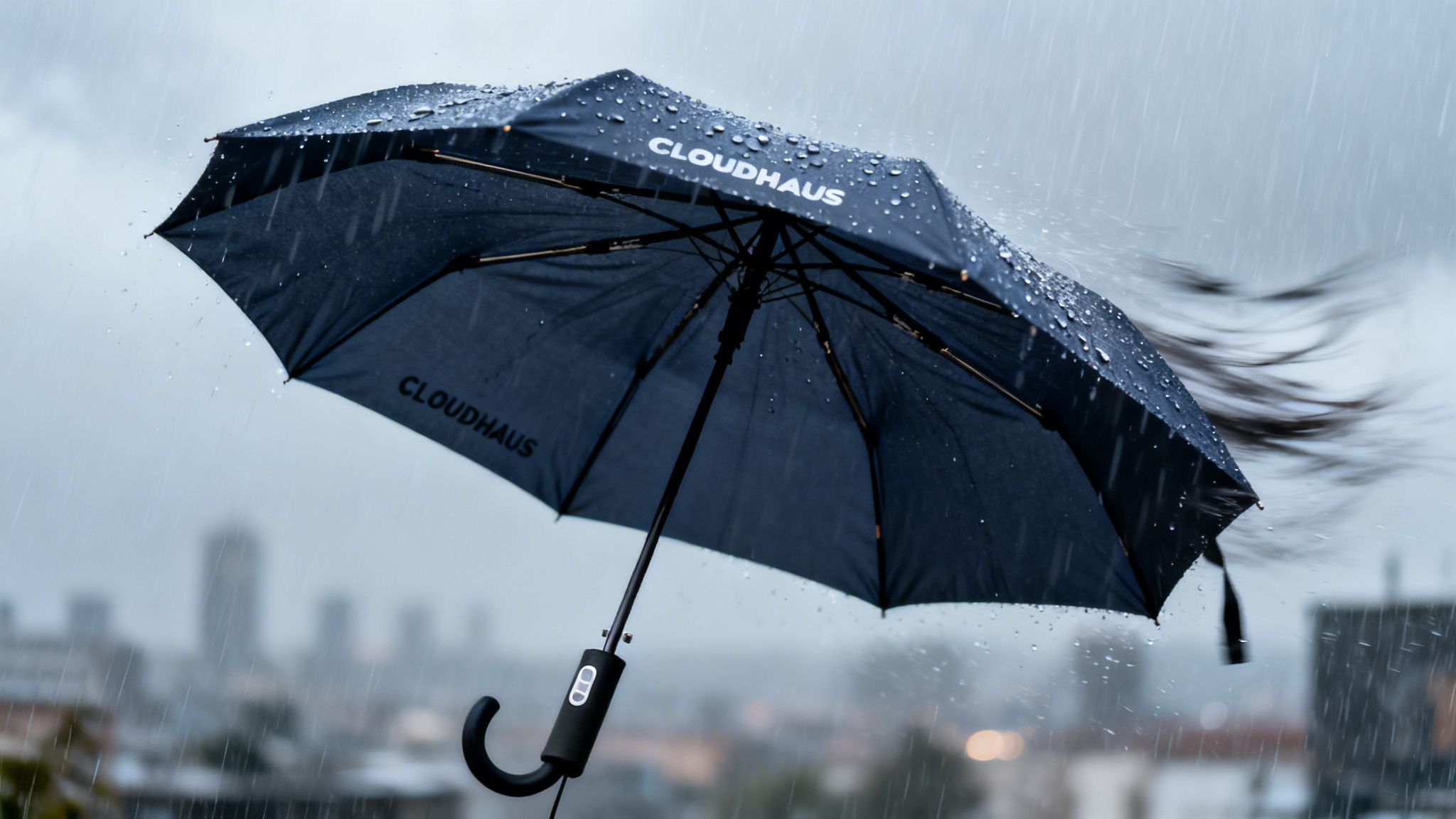
It’s one thing to talk about great design, but it’s another to see it in action. CLOUDHAUS is a brand that takes all the technical details we've covered and turns them into umbrellas that simply work when you need them most. They've clearly looked at why most brollies fail and engineered direct solutions.
Take their StormFlex reinforced fibreglass ribs, for instance. This is their answer to the dreaded umbrella inversion. Instead of using brittle metal that snaps in a strong gust, this material is designed to flex and bend, giving it the resilience to handle the wind and rain. It’s a huge step up from the throwaway frames we’ve all dealt with.
Built for More Than Just Rain
They also use a high-density 190–210T nylon canopy. Not only does this provide excellent waterproofing, but it also offers UPF 50+ sun protection. This simple addition makes the umbrella a genuinely useful all-weather tool, not just something you grab when it’s pouring. A practical example is using it for shade while watching a summer sports match or waiting for a bus on a hot, sunny day. Plus, the one-click automatic mechanism is a lifesaver when you’re caught in a sudden downpour with your hands full.
By offering a complete range—from the compact Mini for travel to the expansive CLOUDHAUS Max with 72 ribs for ultimate coverage—the brand caters to the diverse lifestyles we've identified. Whether you're a daily commuter, a frequent traveller, or need to keep the family dry on the school run, there's a model built for the task.
The demand for this kind of quality has never been higher. In the UK, umbrella consumption shot up by 39% in 2024, reaching 23 million units, with 93% of those being imported. This data, highlighted in a market overview from IndexBox, shows just how many people are searching for a reliable brolly.
To show they stand behind their engineering, CLOUDHAUS offers a few assurances that actually matter.
- 30-Day Money-Back Guarantee: This gives you a chance to feel the quality for yourself, completely risk-free.
- Thousands of Positive Reviews: Their 4.5/5 average rating isn't just a number; it's proof of consistently happy customers.
- Reliable International Shipping: You can get one delivered in just 5–9 business days, making it easy to upgrade your gear.
In the end, CLOUDHAUS is a great example of a brand that gets it right. They’ve combined smart engineering with policies that build real trust, making them a solid and dependable choice in a flooded market.
Your Windproof Umbrella Questions, Answered
Even after getting to grips with the technical side of things, a few practical questions often pop up when you're about to choose an umbrella. Let's clear up some of the most common queries I hear, so you can make your final choice with complete confidence.
How Many Ribs Does a Good Windproof Umbrella Need?
It’s a common trap to get fixated on the number of ribs, but the truth is, the material of the ribs is far more important than the count. An umbrella with 8 to 10 strong, flexible fibreglass ribs will always beat one with 16 flimsy metal ribs that are just waiting to bend or snap.
Think of it like a modern tent pole. It’s designed to flex under pressure and bounce back, not break. High-quality umbrella ribs made from fibreglass or carbon fibre work on exactly the same principle. They absorb the force of the wind, bend with a powerful gust, and then return to their original shape. For a practical test, gently bend a rib on a potential purchase; if it feels rigid and unyielding, it's likely cheap metal. If it has a controlled flex, it's probably a more durable material like fibreglass.
My advice is to focus on the material first. Look for an umbrella with reinforced fibreglass ribs. Once you've confirmed the quality, then a higher rib count (10, 12, or even 16) adds another layer of structural strength and support across the canopy. It's that combination of quality material and sufficient quantity that delivers real wind resistance.
Is a Vented Canopy Actually Worth It?
If you live anywhere that gets more than a light breeze, a vented (or double) canopy isn't just a nice-to-have; it's a game-changer. It's probably the single most effective feature for preventing your umbrella from turning inside out.
The design itself is brilliantly simple. The overlapping layers of fabric create vents that act as a pressure-release valve. When a strong gust of wind gets caught under the canopy, the air has somewhere to go—it escapes through the vents instead of building up and forcing the entire frame upwards.
- Here’s a real-world comparison: Try holding a solid sheet of plywood in the wind. Now, imagine holding a chain-link fence instead. The fence is infinitely easier to control because it lets the wind pass through. A vented canopy does the same job for your umbrella, dramatically reducing the strain on both your arm and the frame.
So, while it might not be essential for a light drizzle with no wind, a vented canopy is a must for a truly windproof umbrella. It provides that crucial fail-safe that makes it much easier and safer to handle in unpredictable weather.
Can I Use a Windproof Umbrella for Sun Protection Too?
Yes, you absolutely can. In fact, many of the best umbrellas for wind and rain are designed as dual-purpose tools, offering fantastic protection from the sun's harmful rays.
To make sure you're getting proper sun defence, check for a UPF (Ultraviolet Protection Factor) rating. This usually comes from a special coating applied to the canopy fabric—you’ll often spot it as a black or silver lining on the underside. A UPF 50+ rating is the gold standard here, as it means the fabric blocks over 98% of harmful UVA and UVB rays. This simple feature turns your rain umbrella into a year-round companion for staying protected, no matter what the forecast says. For example, it becomes a personal shade provider at a summer festival, a picnic in the park, or even during a long walk on a sunny day, protecting your skin from damage.
Ready to invest in an umbrella engineered for real-world conditions? Explore the full range at CLOUDHAUS, where smart design meets lasting durability. Find your perfect model today at https://cloudhausco.shop.
Made with Outrank tool